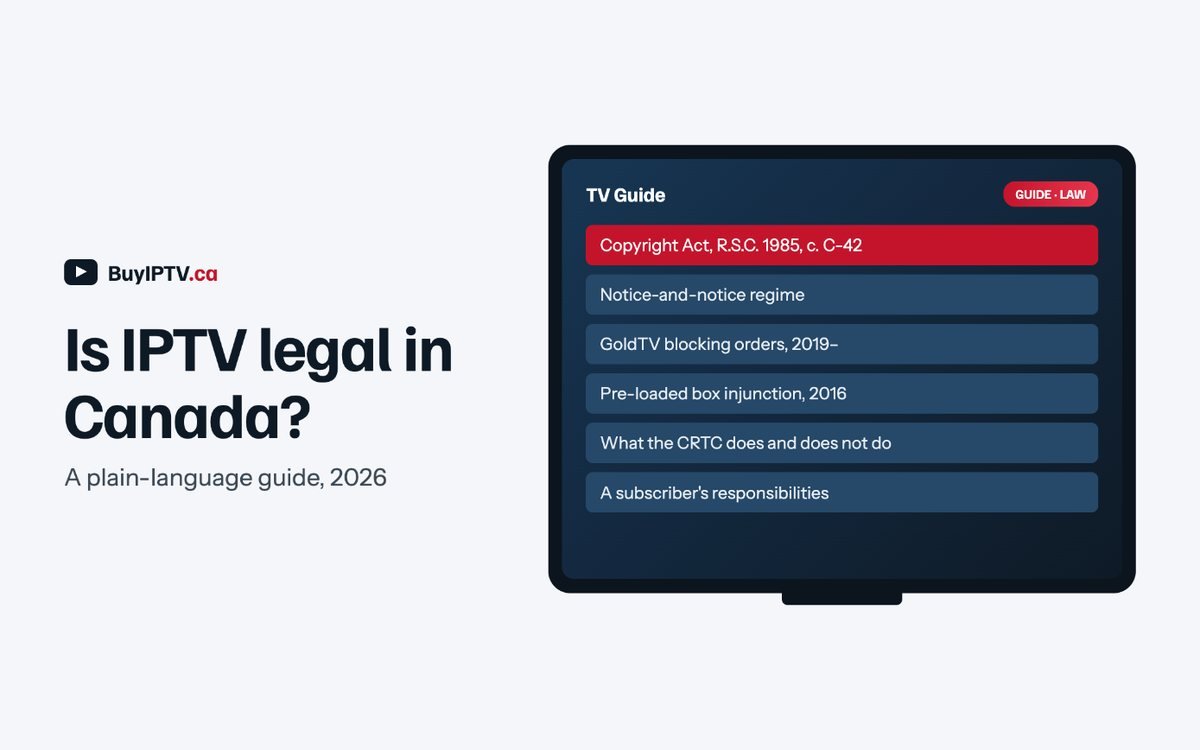
- Is IPTV legal in Canada? The technology is; what matters is whether a service holds the rights to what it streams. “IPTV” describes how TV is delivered over an internet connection, and the largest IPTV services in Canada are Bell, Telus and Vidéotron.
- The Copyright Act governs it: communicating a broadcast or a film to the public without authorization infringes, and since 2012 it specifically targets services designed to enable infringement.
- Under notice-and-notice, your ISP forwards a rights holder’s notice but does not hand over your name without a court order, so a notice alone does not settle your IPTV legal position. Statutory damages for non-commercial infringement are capped at $5,000 in total for all works in a proceeding.
- The Federal Court has ordered ISPs to block unauthorized IPTV domains since GoldTV in 2019, upheld on appeal in 2021, and has granted dynamic orders for live sports since 2022. Those orders target operators, not viewers.
- The CRTC regulates broadcasters and distributors. It does not licence apps or protocols, and in 2018 it declined to run a site-blocking scheme itself, leaving the IPTV legal question to the Federal Court and the Copyright Act.
Is IPTV legal in Canada? It depends what “IPTV” means
Internet Protocol Television is television delivered as data packets over an IP network instead of a cable’s radio-frequency channels or a satellite downlink. That is the whole definition. When Bell rolled out Fibe TV, Telus launched Optik TV and Vidéotron replaced its boxes with Helix, each moved to IPTV; Rogers Ignite TV is IPTV over Rogers’ cable plant. Those are licensed broadcasting distribution undertakings under the Broadcasting Act, they pay the networks whose channels they carry, and nobody asks the IPTV legal question about them, because the rights are already paid for.
The word has picked up a second meaning: a subscription bought from a website, played through an app such as IPTV Smarters or TiviMate, offering thousands of channels for a fraction of cable’s price. Those are also IPTV in the technical sense. Whether one is lawful depends on a question the technology cannot answer: does the operator have permission to communicate that programming to the public in Canada? A service that does is legal and happens to use IPTV apps. One that does not is infringing copyright, and the apps do not change that.
So the honest answer to “is IPTV legal in Canada” is that the question is malformed. The useful question is “is this particular service authorized to show me this particular channel”, and the rest of this article is about how Canadian law handles services that are not.
What makes an IPTV legal question different from a piracy charge?
The Copyright Act, R.S.C. 1985, c. C-42, is the statute that matters. Section 3 gives the owner of a work the sole right to communicate it to the public by telecommunication, section 21 gives broadcasters a similar right in their signals, and section 27 says that doing either without consent infringes.
The Copyright Modernization Act of 2012 added two provisions for online services: a “making available” right in section 2.4(1.1), and section 27(2.3), which makes it an infringement to provide an internet service that a person knows or should know is designed primarily to enable infringement, if infringement results. That is the provision rights holders have leaned on against unauthorized IPTV operators and box sellers, and it is the core of the IPTV legal question courts have had to decide.
One more section explains why an internet service cannot do what cable does. Section 31 gives cable and satellite distributors a compulsory licence to retransmit over-the-air signals such as CBC and CTV on payment of royalties. Parliament carved internet-only retransmitters out of that licence after the iCraveTV dispute of 2000, so a service streaming CTV Toronto gets no benefit from section 31 and needs direct permission instead. “It’s free over the air anyway” is not a defence, and it does not change the IPTV legal question section 31 already answers.
The Criminal Code is mostly beside the point for a viewer. The Copyright Act’s own offences are directed at commercial-scale conduct such as selling infringing copies, and we are not aware of any prosecution in Canada of a person for watching a stream. That keeps the IPTV legal question a civil one for viewers, not a criminal one.
Is IPTV legal in Canada, or does it depend on who is behind the service?
A licensed service has agreements with the rights holders for every channel and title it carries in Canada. That is why Bell’s line-up differs from Telus’, and why the Premier League moves between broadcasters every few years. The service is either a licensed distribution undertaking (cable, satellite, Fibe, Optik) or an online service under the CRTC’s digital media framework, such as Crave or Sportsnet+. Someone signed a contract and money flows to the people who make the programming, which is the short version of the IPTV legal question.
An unauthorized service takes broadcast feeds it has no agreement for and retransmits them. The signs are what you would expect: every sports network in one package for a price that could not cover the rights to any one of them; premium channels included; marketing that says “cut the cord”; cryptocurrency-only payment; no company name or notice policy anywhere. The Federal Court’s decisions describe services of this type, and the pattern is a fair shortcut for the IPTV legal question when you cannot check the paperwork yourself.
| Signal | Licensed or authorized service | Unauthorized service |
|---|---|---|
| Who is behind it | A named company, usually with a CRTC licence or registration, a Canadian address and a phone number | Often no legal name, no address, a domain registered by proxy |
| Channel line-up | Limited by what the operator has licensed; regional restrictions are real | Everything from every country, no blackouts, no gaps |
| Price | Reflects rights costs; sports tiers cost extra | A few dollars a month for all of it |
| Marketing | Sells its own catalogue | Sells “free” access to someone else’s; “no more cable bills” |
| Notice and takedown policy | Published, with a contact, and acted on | Absent, or a copied page with no working address |
| Payment | Card, Interac, PayPal, with a receipt | Cryptocurrency or gift cards only, or a card processor that changes monthly |

How does the notice-and-notice regime work?
Sections 41.25 to 41.27 of the Copyright Act, in force since January 2015, created notice-and-notice. A rights holder who believes an internet account has been used to infringe sends a notice to the ISP; the ISP must forward it to the account holder and keep a record for six months, or a year if proceedings start. The ISP does not disclose who the customer is; a rights holder who wants a name has to go to court for a disclosure order.
Since a 2018 amendment a notice may not contain an offer to settle, a demand for payment or a request for personal information, which ended the “pay $300 now” letters some Canadians received in the regime’s first years. A notice that does is non-compliant and the ISP is not required to forward it, worth knowing before you worry too much about your IPTV legal position.
The regime is built around identifiable activity from an IP address, and the notices Canadians receive have mostly related to peer-to-peer file sharing, where the account uploads as well as downloads. Watching a live stream uploads nothing to other viewers, one reason notices for IPTV viewing are rare, and one reason the IPTV legal question rarely reaches a typical streaming viewer as a notice. Rare is not impossible: a rights holder that identifies a subscriber another way, such as a seized customer database, does not need the notice regime.
The financial exposure for an individual is set out in section 38.1. Where infringement is for non-commercial purposes, a rights holder who elects statutory damages instead of proving actual loss can recover between $100 and $5,000, and that is the total for all works and all rights holders in the proceeding, not per film or per channel.
For commercial-purpose infringement the range is $500 to $20,000 per work, which is why a bar showing a match through an unauthorized service is in a very different position from a household. Courts keep discretion within those ranges and the section has other conditions, so treat the figures as the shape of the rule rather than a promise. Proven actual damages are not capped.
Is IPTV legal in Canada once a court orders the domain blocked?
The most significant Canadian development for unauthorized IPTV has been orders against services’ domains, not actions against viewers. In Bell Media Inc. v. GoldTV.Biz, 2019 FC 1432, Bell, Rogers and Groupe TVA sued GoldTV’s unknown operators and asked the Court to order Canada’s major ISPs to block its domains and IP addresses. On November 15, 2019, Justice Gleeson granted the first site-blocking order in Canadian copyright law, finding jurisdiction, plain infringement, and proportionality given the defendants’ earlier ignored injunctions.
TekSavvy appealed, arguing the order needed CRTC approval under the Telecommunications Act. The Federal Court of Appeal dismissed the appeal in Teksavvy Solutions Inc. v. Bell Media Inc., 2021 FCA 100, and the Supreme Court of Canada declined to hear the case in 2022. The decisions are on the Federal Court’s decisions site, readable by a non-lawyer and a good place to check the IPTV legal question yourself.
GoldTV was a static order: a list of domains. Live sports move too fast for that, since a pirate stream can appear on a new domain in the first period and vanish by the third. In Rogers Media Inc. v. John Doe 1, 2022 FC 775, the Court granted a dynamic site-blocking order for the rest of the 2021–22 NHL season: Rogers, Bell and their co-applicants identify infringing servers in real time during live games, and the ISPs block those addresses for the broadcast window, with safeguards and reporting.
The Court has since renewed and broadened that approach across later seasons and other live sports properties held by the applicants. We describe it in general terms because the properties and safeguards change from order to order, and the current terms are in the orders themselves, which is a reminder that the IPTV legal question around live sports keeps moving faster than any single guide can.
What those orders do and do not do is worth stating plainly. They bind the named ISPs and target the servers and domains of operators the Court has found infringing. They do not identify, fine or notify viewers. From a subscriber’s chair, the visible effect is a channel going dark during the game or the service’s website ceasing to resolve, and the operator moving to a new address, usually the only visible sign that the IPTV legal question in the background was ever decided.

Is IPTV legal in Canada when it comes pre-loaded on a box?
Before site blocking, the first modern Canadian IPTV case concerned hardware. In Bell Canada v. 1326030 Ontario Inc. (iTVBox.net), 2016 FC 612, Bell, Rogers and Vidéotron sued retailers who sold Android boxes pre-loaded to stream television without authorization, marketed as a way to “cancel cable”. Justice Tremblay-Lamer granted an interlocutory injunction stopping the sales, finding a strong prima facie case of inducing infringement and providing a service designed primarily to enable it. The Federal Court of Appeal upheld the injunction in Wesley (Mtlfreetv.com) v. Bell Canada, 2017 FCA 55.
The reasoning matters more than the outcome. The retailers argued they only sold general-purpose computers and any infringement was done by customers. The Court rejected that: the boxes were sold on what they could pull in without paying, apps already installed. The lesson today is that marketing is evidence, often the clearest signal in the IPTV legal question a buyer can check alone. A seller advertising “every PPV free” or “never pay Bell again” is describing its own product in the terms the Court used to find a strong case of infringement.
| Year | Case or event | Court | What it decided |
|---|---|---|---|
| 2015 | Notice-and-notice in force (ss. 41.25–41.27) | Parliament | ISPs forward notices; no disclosure of identity without a court order |
| 2016 | Bell Canada v. 1326030 Ontario Inc. (iTVBox), 2016 FC 612 | Federal Court | Injunction against sellers of pre-loaded streaming boxes; upheld 2017 FCA 55 |
| 2018 | FairPlay Canada application, Telecom Decision CRTC 2018-384 | CRTC | Declined to create an administrative site-blocking regime, citing jurisdiction |
| 2019 | Bell Media Inc. v. GoldTV.Biz, 2019 FC 1432 | Federal Court | First order requiring ISPs to block an unauthorized IPTV service’s domains |
| 2021 | Teksavvy Solutions Inc. v. Bell Media Inc., 2021 FCA 100 | Federal Court of Appeal | GoldTV order upheld; no CRTC approval required for a court-ordered block |
| 2022 onward | Rogers Media Inc. v. John Doe 1, 2022 FC 775 and later orders | Federal Court | Dynamic blocking of infringing servers during live sports broadcasts, renewed and extended since |
Judge a service on what it publishes. Our notice policy, terms and refund policy are on the site with a working contact, and the free trial asks for an email, nothing else. Start the 24-hour free trial
Is IPTV legal in Canada if the CRTC has not weighed in?
The Canadian Radio-television and Telecommunications Commission regulates broadcasting under the Broadcasting Act and carriers under the Telecommunications Act. It licenses cable, satellite and IPTV distributors, sets Canadian-content rules, and, since the Online Streaming Act amended the Broadcasting Act in 2023, requires large online streaming services above a revenue threshold to register too. None of that touches the IPTV protocol, the player apps or an individual subscriber, which keeps the IPTV legal question outside the CRTC’s mandate. The CRTC does not certify apps, keep a list of banned services, or investigate households.
It also does not enforce copyright. In 2018 a coalition of broadcasters and ISPs called FairPlay Canada asked the CRTC to set up an agency that would identify piracy sites and require ISPs to block them. In Telecom Decision CRTC 2018-384 the Commission declined, saying the Telecommunications Act did not give it that jurisdiction and that copyright was a matter for Parliament and the courts.
That is why site blocking in Canada runs through the Federal Court rather than the regulator, and why the Court of Appeal in GoldTV had to decide whether a court order needed the CRTC’s blessing. It held that it did not. The CRTC’s public lists of licensed and registered undertakings are the place to check whether a service claiming to be a licensed distributor actually is one, a faster check than researching the IPTV legal question from scratch.
Is IPTV legal in Canada for the person just watching?
If you are asking “is IPTV legal in Canada” to stay on the right side of it, this is the section that matters. Canadian law puts the primary obligation on the person communicating the work to the public, which is the operator, and the reported cases have been against operators and sellers. That does not make the subscriber a bystander: you are the person choosing the service, paying it and, to your ISP, the account through which it is watched.
Know what you are buying. Read the site: does it name a company, publish a notice policy with a contact, and describe its channels honestly? If it markets itself as a way to get paid content free, it has answered the IPTV legal question about itself.
Do not resell, share credentials beyond your household, restream, or record programming for anyone else; each moves you from viewer toward distributor, and commercial-purpose infringement carries the higher damages range. Bars and restaurants need a commercial licence for sports; a consumer IPTV login is not one.
Take a notice seriously if you get one. A forwarded notice usually names the work and IP address involved, without demanding payment or your details, since the 2018 amendment bans both. It is not a lawsuit or a fine, and does not require a reply, but it means a rights holder has associated your account with something worth stopping.
If a notice mentions a settlement offer, a dollar demand or your personal details, it is not compliant; keep it anyway and consider asking a lawyer whether to respond at all. Keep records of what you paid for, and accept that the law moves: dynamic blocking orders did not exist in 2021, and your IPTV legal position in 2029 may not be what it is today.

Why does a provider’s marketing matter to the IPTV legal question?
Every case above turned in part on how the defendant presented itself. The iTVBox retailers advertised free TV; the GoldTV operators sold every premium channel for a few dollars; the FairPlay application listed sites whose entire pitch was piracy — each a different face of the same IPTV legal question.
Against that background, a provider that publishes a written notice policy, names a contact for rights holders, removes content on a valid complaint, and does not market itself as a way to avoid paying for TV is behaving the way a legitimate online service behaves — and, as a matter of self-interest, is the provider least likely to disappear with a year of your money.
That is the standard we hold ourselves to. Our notice policy is public and acted on, our marketing is about price, regional feeds and support rather than “beating” Bell or Rogers, and our about page says who we are. We do not tell customers that subscribing to us, or to anyone, makes questions of licensing go away, because that would not be true.
A provider that says it is “100 per cent legal” without explaining what it has licensed is asking you to take a legal conclusion on faith rather than answering the IPTV legal question at all. Ask us, or anyone else, what we can show you. If the answer is a policy page and a contact replying within published support hours, at least someone is accountable. If it is a Telegram username, you have learned something too.
If cost is the reason you are here, our guide to what IPTV costs in Canada covers the tiers, and the Firestick app comparison covers the players. The pricing page, channel list and setup guides hold the practical detail, and the Toronto and Vancouver pages show the regional feeds on a real login.
Is IPTV legal in Canada? Frequently asked questions
Is IPTV legal in Canada?
That depends on the service, not the technology. IPTV is a way of delivering television over an internet connection, and Bell Fibe TV, Telus Optik TV, Vidéotron Helix and Rogers Ignite TV all use it. What can be unlawful is a specific service retransmitting channels it has no rights to. The technology and the apps are not the issue; authorization is.
Is IPTV legal in Canada if I only watch, never sell or share?
Canadian enforcement to date has been against operators, box sellers and domains, and the notices households receive have mostly concerned peer-to-peer sharing. We are not aware of a Canadian case against a person for watching a stream, but that describes what has happened, not what cannot. If you receive a notice, take it seriously.
What is the maximum I could owe for non-commercial copyright infringement?
Under section 38.1 of the Copyright Act, statutory damages for non-commercial infringement range from $100 to $5,000 total for all works in the proceeding. Commercial-purpose infringement is $500 to $20,000 per work. A rights holder can instead prove actual damages, which are not capped. Conditions apply, so read the section or ask a lawyer rather than treat any figure here as the final word on your IPTV legal position.
Will my ISP give my name to a rights holder?
Not on its own. Under notice-and-notice the ISP forwards the notice and keeps records, but disclosing who you are requires a court order. Since 2018 a notice may not include a settlement demand, and one that does is not compliant.
Is IPTV legal in Canada if the CRTC has not banned it?
Not on its own. The CRTC licenses broadcasters and distributors and registers large streaming services, but it does not certify or ban apps or protocols, and in 2018 it declined to run a site-blocking regime. Whether a service is authorized is a copyright question, and blocking orders come from the Federal Court under the Copyright Act, not the CRTC.
Does a VPN make IPTV legal in Canada?
No, and a VPN does not change the legal position of a service; it only hides your traffic from your ISP. A Canadian provider works on Bell, Rogers, Telus, Vidéotron, Shaw and every reseller without one, and a foreign VPN server puts your guide in the wrong time zone.
Is IPTV legal in Canada for a bar or restaurant using a home subscription?
No. Showing programming in a business needs a commercial licence, the broadcasters and leagues check, and commercial-purpose infringement carries the higher statutory damages range. Consumer plans, including ours, are for households only.
Is IPTV legal in Canada when the provider is offshore?
Not automatically. The Federal Court’s blocking orders, including GoldTV and the dynamic sports orders, have targeted domains regardless of where the operator claims to be based, because the infringing communication is received in Canada. An offshore address does not put a service outside the Copyright Act, and usually means less recourse if the operator disappears with your payment.
Is this page legal advice?
No. It is general information about Canadian law as we understand it in September 2026, written by a company that sells IPTV subscriptions. For advice about your own situation, speak to a lawyer licensed in your province.
Disclosure: we run BuyIPTV.ca, an IPTV service for Canadian households, so weigh our take accordingly. Prices and channel line-ups are correct as of September 2026.