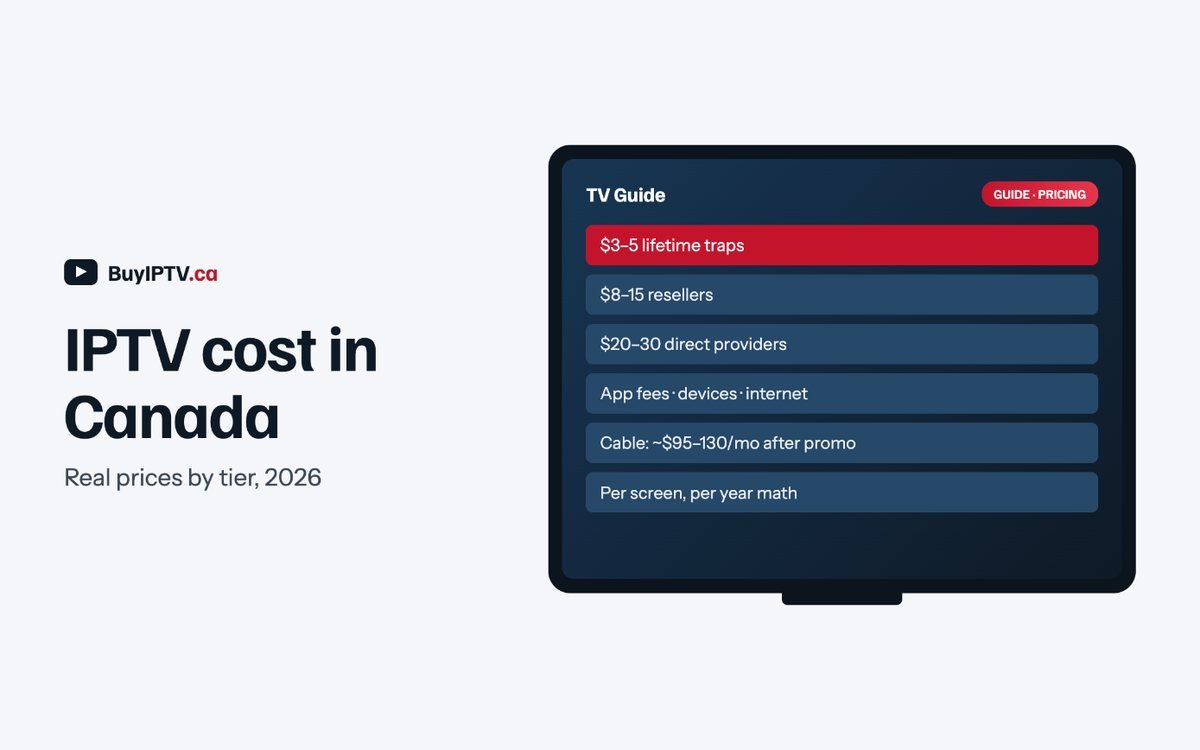
- IPTV cost in Canada is really three prices, not one. Three real tiers: $3–5 “lifetime” or reseller-of-reseller deals, $8–15 resellers, and $20–30 direct providers. Price buys support hours, server headroom on game nights and a refund policy, not more channels.
- Hidden fees add to the IPTV cost: a one-time ~$10–15 app activation on Samsung and LG TVs, a $40–70 Firestick if your TV needs one, and 15 Mbps of internet per screen.
- Yearly billing is what actually lowers the IPTV cost: a $22 monthly plan is $264 a year, the same service billed yearly is $115, under $5 a screen per month.
- Mid-tier cable from Bell, Rogers, Telus, Vidéotron, Eastlink, SaskTel or Bell MTS commonly lands at ~$80–125 a month after the first-year promo, before add-ons.
- The only honest test of a cheap service is a 7 pm ET game night on your worst Wi-Fi spot.
What is the real IPTV cost in Canada in 2026?
The real IPTV cost in Canada depends on which of three tiers you are looking at. Search “iptv canada” and you will see prices from $3 to $30 a month for what looks like the same product. Channel counts are nearly meaningless as a comparison, because most services draw from the same handful of upstream sources. What varies with price is everything that is not a channel: whether a person answers when Sportsnet Ontario drops out in the second period, whether the server holds on a Saturday when the Leafs, Canadiens and Oilers all play, and whether you can get your money back if it does not.
We run a service in the third band, so read what follows knowing that. Both other tiers have a place; a student in a Halifax basement with one TV has different needs from a family in Surrey with three screens and a Canucks season to follow.
Does a $3 to $5 “lifetime” deal really lower your IPTV cost?
The cheapest tier is sold on Kijiji, in Facebook groups, or through a friend of a friend. The seller is usually a reseller of a reseller, each layer marking up a block of credits bought from the one above. At $3 to $5 a month, or $30 to $50 for a “lifetime”, the price only works if a good share of buyers never renew and never complain.
What you get is a login that works today. What you do not get is anyone who can fix it when it does not. The person you paid cannot see the server, move you to another one, or restore a channel. “Lifetime” means the lifetime of the panel they resell, and panels in this tier tend to be shut down or re-branded within months. The buyers start over with a new $3 login, and across a year often land on the middle tier’s IPTV cost anyway, with weeks of dead TV between.
This tier also rarely carries regional Canadian feeds: often one “Sportsnet” and one “TSN”, typically the Ontario feed and TSN 1, so an Oilers fan in Edmonton is looking at the wrong game on most regional nights. For one league or one foreign-language channel from a seller you know, a few dollars can be worth it, and the IPTV cost stays trivial at that scale. Do not build the household’s TV around it.
What is the IPTV cost with an $8 to $15 reseller?
This is the biggest tier by volume in Canada. A reseller here has a direct relationship with a panel, buys credits wholesale and sells them at a margin that leaves room for a little support. Many are one-person operations run in the evenings; the better ones are honest about what they are, and one whose customers you know personally can be a fine deal.
The limits are structural. Support hours are the reseller’s own hours, so a channel that fails at 8 pm on a Saturday waits until they are off shift at the day job. Server capacity is decided by the panel, and on the nights it matters most the panel has thousands of other resellers’ customers on the same hardware. Refund policies are usually informal, a polite way of saying there is not one, because the reseller has already paid for the credits.
Regional feeds depend on the panel. You are paying for a service that is usually good, from a person who is usually reachable, on a server that is usually fine, and the IPTV cost you pay here buys exactly that: usually, not always. Whether “usually” is enough depends on how much you care about the nights it is not.

Why is the IPTV cost $20 to $30 with a direct provider?
The top tier is providers that control their own infrastructure: streaming servers they run or manage, their own payment processing, staffed support with published hours, a written refund policy, and a channel list they can actually change. Those cost money every month whether or not a given customer renews: support in Canadian hours, in English and French, is a payroll line, and sports capacity that holds on a Saturday in November means servers that sit half empty on a Tuesday in July. That is why the IPTV cost sits higher here than in the other two tiers.
What that buys: a reply at 9 pm on a Saturday from someone who can see the server and move your account; every Sportsnet region and TSN feed, so the guide in Calgary defaults to Sportsnet West and the guide in Montréal shows RDS and TSN 2; a 7-day catch-up that works because the recordings are made on the provider’s side; and a reasonable expectation that the company is still there in twelve months. It is still IPTV over your home internet, and nobody in this tier can make a 2.4 GHz connection in a Liberty Village condo stream 4K.
What hidden fees push up your IPTV cost?
App activation on Samsung and LG. The apps that run natively on those TVs, IBO Player, Smart IPTV and their cousins, typically charge a one-time ~$10 to $15 CAD per TV after a short trial, tied to the TV’s MAC address. Firestick and Android TV users mostly avoid this, because IPTV Smarters Pro is free; our Firestick app comparison covers the options.
A streaming device. If your TV is older, the usual answer is a Fire TV Stick: budget ~$40 to $50 for the HD model and ~$60 to $70 for the 4K model at full price, less in November. An Ethernet adapter is another ~$20 to $25 and is the single best fix for a stuttering stream.
Internet. Budget 15 Mbps per screen for Full HD and 25 Mbps for 4K; the cheapest plans Rogers, Bell, Telus, Vidéotron and Shaw sell are well above that. The exception is capped rural fixed wireless or satellite, where nightly streaming can use 300 to 500 GB a month, and overage charges there matter more to your total IPTV cost than the subscription itself.
A second subscription. If a $4 login dies in March and you buy another in April, the second is a cost of the first. Three logins in a year is common in the cheap tier, and it quietly pushes the real IPTV cost above what a direct provider’s yearly plan would have cost. What you do not need is a VPN; a provider that serves Canadians works on every Canadian ISP without one.

What does IPTV cost per screen and per year?
Per-screen and per-year math changes how IPTV cost in Canada looks. Yearly prices are what most households actually pay, and the gap from monthly is large. Using our own plans as the worked example: Standard is $22 a month, $45 for three months, $79 for six or $115 for twelve, with two screens; Pro is $29 a month, $65 for three months, $105 for six or $145 for twelve, with five screens, PPV events and priority sports servers. All in CAD, tax included.
| Plan and term | Total for 12 months | Per month | Screens | Per screen, per month |
|---|---|---|---|---|
| $4 “lifetime” login, replaced twice | ~$100–150 across three purchases | ~$8–12 | 1 (usually) | ~$8–12 |
| Standard, paid monthly | $264 | $22 | 2 | $11 |
| Standard, 12 months | $115 | $9.58 | 2 | $4.79 |
| Pro, paid monthly | $348 | $29 | 5 | $5.80 |
| Pro, 12 months | $145 | $12.08 | 5 | $2.42 |
A monthly plan from a direct provider costs more than twice its yearly equivalent, which is why we tell people to run the 24-hour trial, buy one month if they are nervous, then move to yearly once they trust it. Per-screen pricing also changes the cable comparison: Rogers and Bell charge ~$10 a month for each additional box, so Pro at $145 a year gives five screens for about the cost of one extra cable box over the same period, before a single channel is paid for. Term length, not tier, is what moves the IPTV cost the most.
Test before you pay. The 24-hour free trial needs an email address and nothing else, no card and no commitment. Run it on a game night on the TV you actually use, and if it holds, the yearly plan is where the savings are. Start the free trial
How does the IPTV cost compare with cable, province by province?
Cable pricing in Canada is deliberately hard to pin down: a first-year promotional rate that requires bundling with internet, then a regular rate that is not on the front page. The figures below are the ranges we see from customers and rate cards for a mid-tier package with one PVR, after the promotion, before add-ons. They are illustrative and change every few months; the shape of the comparison does not.
Cable figures below are typical published rates once promotions end. For the official averages, the CRTC’s Communications Market Reports track what Canadian households actually pay for TV year over year.
| Province | Provider and mid-tier package | Commonly ~ per month after promo | Twelve months, roughly |
|---|---|---|---|
| Ontario | Bell Fibe TV, Good tier | ~$95–120 | ~$1,150–1,450 |
| Ontario, New Brunswick | Rogers Ignite TV, Popular tier | ~$100–125 | ~$1,200–1,500 |
| Québec | Vidéotron Helix, mid-tier | ~$85–110 | ~$1,000–1,300 |
| Québec | Bell Fibe TV, Bon tier | ~$90–115 | ~$1,100–1,400 |
| British Columbia, Alberta | Telus Optik TV, mid-tier | ~$90–115 | ~$1,100–1,400 |
| BC, Alberta, Saskatchewan, Manitoba | Shaw, now Rogers Ignite in the West, Popular tier | ~$95–120 | ~$1,150–1,450 |
| Nova Scotia, PEI, Newfoundland | Eastlink TV, mid-tier | ~$85–110 | ~$1,000–1,300 |
| Atlantic provinces | Bell Aliant Fibe TV, Good tier | ~$90–115 | ~$1,100–1,400 |
| Saskatchewan | SaskTel maxTV, mid-tier | ~$80–105 | ~$950–1,250 |
| Manitoba | Bell MTS Fibe TV, mid-tier | ~$85–110 | ~$1,000–1,300 |
| Anywhere in Canada | BuyIPTV.ca Standard, 12 months | $9.58 | $115 |
| Anywhere in Canada | BuyIPTV.ca Pro, 12 months | $12.08 | $145 |
The add-ons are where the cable bill grows. A sports tier that unlocks the extra Sportsnet regions and TSN feeds is commonly ~$10 to $20 a month; a single-language theme pack ~$15 to $30, and a household in Brampton or Surrey that wants two languages pays twice; extra TVs ~$10 each. A realistic all-in bill for a family that watches sports and one language from home is closer to $150 a month than $100.
To be fair, cable also buys the box, the technician and a company you can complain to the CRTC about, and that is worth something. But measured only in dollars, the IPTV cost and the cable bill are not close: our channel list shows what $115 includes without a single add-on.
How do you test whether a cheap service is worth it?
Price is easy to compare; reliability can only be tested, and the IPTV cost alone will not tell you which service survives a Saturday night. This is the test we would run on any service, including ours.
- Get a trial without paying. A service that will not give you a day for free is telling you something about its confidence. One that asks for a card to “verify” a free trial is telling you something else.
- Test at 7 pm ET on a Saturday. Hockey Night in Canada plus every regional game is the peak load of the week. That is 4 pm in Vancouver and 8 pm in Halifax, and it is when underprovisioned servers fall over.
- Check your regional feeds by name. Sportsnet Pacific in BC, TSN 3 for the Jets, RDS in Québec, CTV Halifax for local news in Atlantic time. If the list only says “Sportsnet”, it is probably the wrong one.
- Look at the guide clock. If the 7 pm game is listed at 4 pm, the service does not handle Canadian time zones.
- Try catch-up on yesterday’s game. Seven-day catch-up is advertised by everyone and works for fewer.
- Email support on the weekend. Ask an easy question and time the reply. The answer tells you the hours, the language, and whether a person or a template is on the other end.
- Read the refund and notice pages. A written 30-day money-back policy, a refund page and a notice policy are signs of a business that expects to be around; we cover why in our guide to IPTV and Canadian law.
- Test your worst Wi-Fi spot. The bedroom TV on the far side of the house, not the living room next to the router. If it fails there, the buffering fixes are next, and an Ethernet adapter usually settles it.
If a $4 service passes all eight, use it. In our experience it fails the weekend support and regional feed tests, and passes the game-night test until the panel is oversubscribed. The middle tier usually passes five or six. The top tier should pass all eight, and if it does not, that is what the money-back policy is for, because the IPTV cost of a bad month should come back to you.

When is cable still the better deal?
It is not the answer a site called BuyIPTV.ca is supposed to give, but some households are better off with cable. If your internet is fixed wireless with a 100 GB cap, streaming every evening costs overage that erases the savings. If all you watch is local CBC and CTV and the Saturday game, an antenna is free. And no consumer IPTV tier is sold for a bar or restaurant.
For everyone else, the arithmetic is not close: $115 or $145 CAD a year on every screen in the house, against $1,000 to $2,000 for cable. The trick is not finding the lowest sticker price; it is finding the IPTV cost that is still honest twelve months from now.
IPTV cost in Canada: frequently asked questions
What is a fair IPTV cost per month in Canada in 2026?
For a service with Canadian regional feeds, published support hours and a written refund policy, $20 to $30 a month paid monthly, or roughly $9.50 to $12 a month on a yearly plan. Below $8 a month you are almost always buying from a reseller of a reseller.
Are “lifetime” IPTV subscriptions real?
They are real logins, but “lifetime” refers to the life of the panel the seller resells, which in the cheapest tier is often measured in months. No provider that runs its own servers sells a lifetime plan, because the IPTV cost of keeping those servers running never goes away.
Do I have to pay for the IPTV app as well as the subscription?
On a Firestick, Android TV, iPhone or Android phone, no: IPTV Smarters Pro is free and TiviMate’s premium features are an optional small unlock. On Samsung and LG smart TVs the native apps commonly charge a one-time activation of about $10 to $15 per TV after a short trial, and that one-time fee is the only device add-on to the IPTV cost on those TVs.
Is the IPTV cost in CAD or USD?
Check before you pay. Many services aimed at Canadians quote and charge in USD, which adds roughly 35 to 40 per cent plus a foreign transaction fee. Ours are charged in CAD, tax included.
How much internet do I need, and will it change my IPTV cost?
About 15 Mbps per screen for Full HD and 25 Mbps for 4K, which every standard cable or fibre plan exceeds. On a capped rural plan, three hours of streaming a night can use 300 to 500 GB a month.
Does a yearly plan really lower the IPTV cost, or should I pay monthly?
Pay monthly until you trust the service, then switch to yearly. A direct provider’s yearly plan is usually less than half the monthly total. With a cheap reseller, never pay for more than a month, because you cannot get it back if the panel disappears.
Does a more expensive IPTV service have more channels?
Not usually. Most Canadian services draw from the same upstream sources, so channel counts are similar across tiers. The extra in the IPTV cost buys support, capacity on busy nights, correct regional feeds and a refund policy, not extra channels.
Can I split the IPTV cost with family in another city?
Yes, within the screen limit. A Pro plan’s five screens can be in a house in Ottawa and a parent’s apartment in Halifax at the same time, and each login can set its own regional default.
Disclosure: we run BuyIPTV.ca, an IPTV service for Canadian households, so weigh our take accordingly. Prices and channel line-ups are correct as of September 2026.